
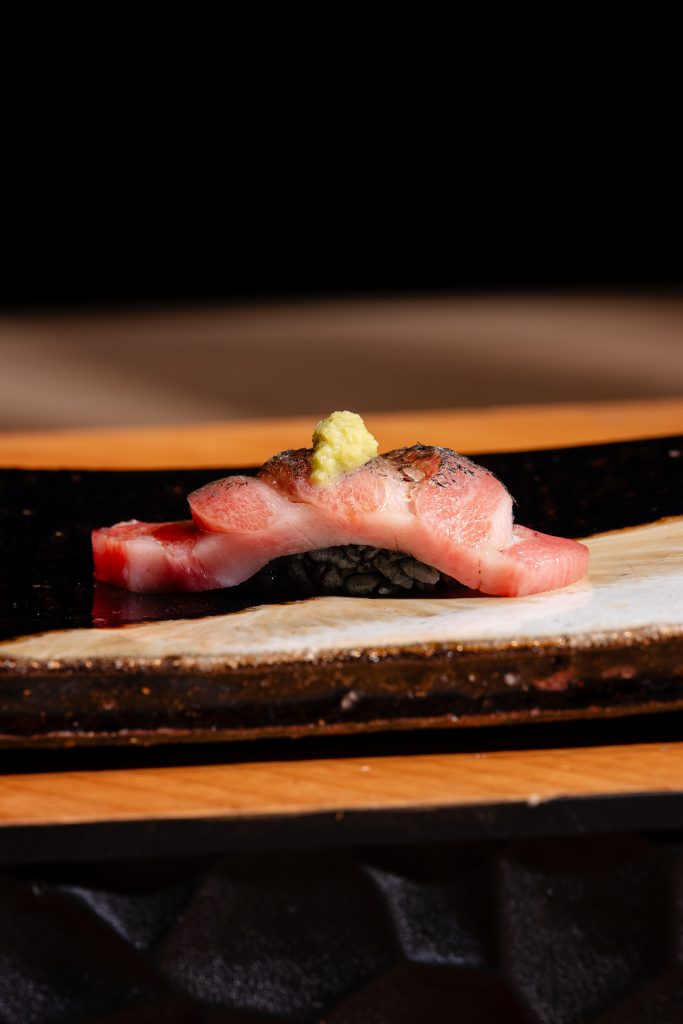
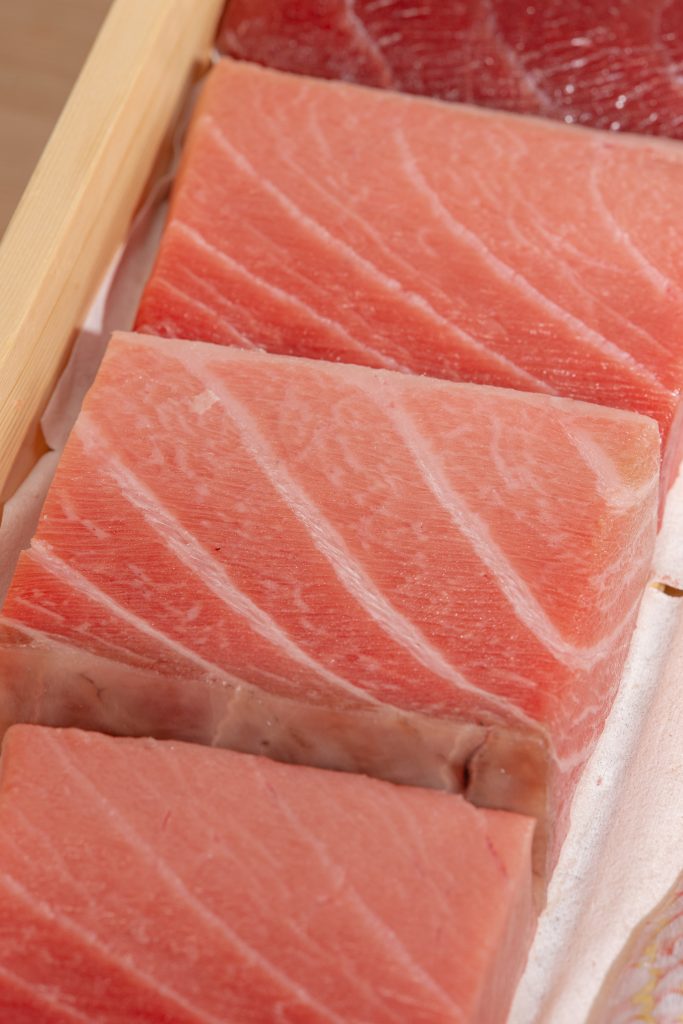
Ōtoro is the fattiest cut of bluefin tuna, typically sourced from the lower belly where marbling is at its most concentrated. This is what gives the cut its signature texture — soft, fluid, and almost immediate in the way it melts across the palate — making ōtoro one of the most recognized elements in omakase sushi.
If akami expresses the sharp clarity of lean tuna, and chūtoro the balance between lean meat and fat, then ōtoro moves fully toward richness. Yet its value lies in more than fat alone. What defines excellent ōtoro is the ability to preserve structure, aroma, and precision within that richness.
In omakase, ōtoro often appears as a moment of emphasis — not simply because it is luxurious, but because of the way it expands on the palate: soft, deep, gradual, and lingering. At the same time, this intensity also makes it one of the most delicate cuts to handle. Without careful control, its richness can become heavy and diminish the clarity that makes it exceptional.
At SABI Sky Omakase in Ho Chi Minh City, ōtoro is finished with a light charcoal sear (aburi). The brief touch of heat warms the surface, gently loosens the outer fat, and brings forward a more defined aroma, while the interior remains soft and supple. A fine layer of smokiness adds depth without overshadowing the natural character of the fish.
Served at its ideal point, ōtoro becomes fuller yet more composed. Its richness feels more integrated, its texture softer yet still supported by structure, and its finish longer, warmer, and cleaner. In this state, ōtoro becomes more than the fattiest cut of tuna — it becomes an example of how abundance can be guided by technique and restraint within a refined omakase experience in Ho Chi Minh City.
Served at its ideal point, ōtoro becomes fuller yet more composed. Its richness feels more integrated, its texture softer yet still supported by structure, and its finish longer, warmer, and cleaner. In this state, ōtoro becomes more than the fattiest cut of tuna — it becomes an example of how abundance can be guided by technique and restraint within a refined omakase experience in Ho Chi Minh City.